
“My electricity bill seems higher than I expected.”
Does that sound familiar?
Some people rarely use air conditioning,
while others run the air conditioner and washer-dryer every day, so electricity use varies widely. Even so, if a bill seems unusually high, there is one section worth checking.
This article explains electricity tariff categories; changing category can sometimes reduce the bill by around half.
Building classifications and utility tariffs
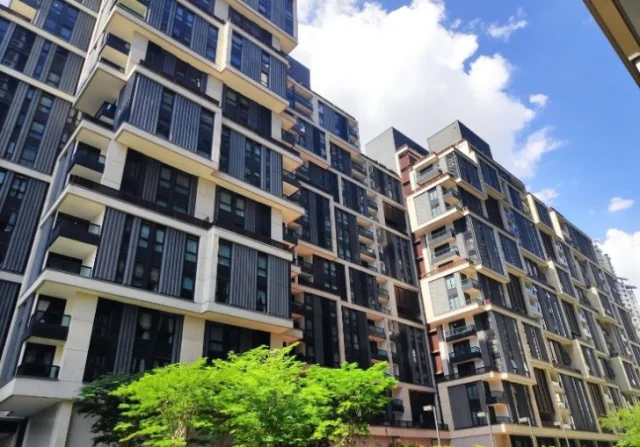
Take Arcoris in Mont Kiara as an example.
It has three blocks: residences, SOHO and offices.
Residences
Building classification: residential
Residential tariffs apply.
SOHO
Building classification: commercial
Commercial tariffs apply, though a switch to residential tariffs may be possible.
Sewerage charges, however, cannot be changed.
Residential internet packages may also be available.
Office block
Building classification: commercial
Commercial tariffs apply and cannot be changed to residential tariffs.
Only business internet packages are available.
Residents familiar with Arcoris may know that the three blocks look very similar from the outside.
Most families live in the residential block, but one-bedroom units are available in both the residential and SOHO blocks.
Because of these different classifications, residential and SOHO units can have significantly different utility and internet costs even with the same location, floor area and rent.
Checking your bill
Check which base tariff applies to your account.
Please check the following two electricity bills.
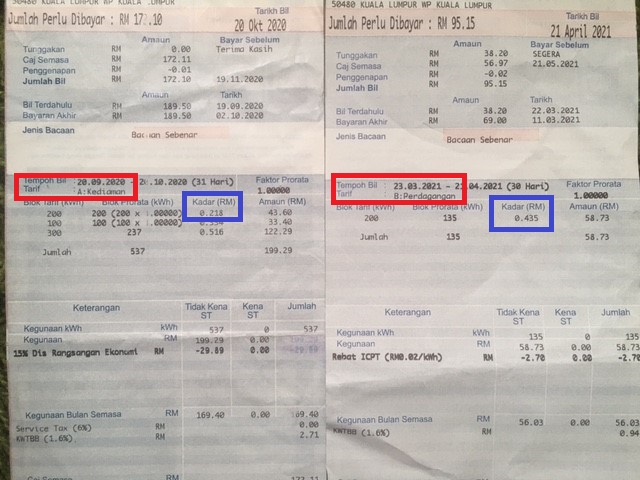
The red boxes show the tariff category.
Kediaman = residential
B. Perdagangan/Komersial = commercial
The blue boxes show the base rate.
The residential base rate for 200 kWh is 0.218.
The commercial rate is 0.435.
Notice how different the base rates are.
If the red box says “Kediaman” (residential), no change is needed.
If it says “B. Perdagangan/Komersial” (commercial), ask your landlord whether a change is possible.
How to request a tariff change
For Tenaga Nasional, only the named account holder can request the change.
This is usually the landlord.
You can ask your landlord:
“Could you check whether the tariff can be changed from commercial to residential?”
If they ask how to check, suggest that they contact the Tenaga Nasional service centre listed on the bill.
Tenaga Nasional usually responds within about a week to confirm whether the change is possible.
Once changed, the new tariff is reflected on the following month’s bill or the bill after that.
It is not an error made by the landlord; consider a successful change a welcome benefit.
The landlord cannot be asked to cover the difference before the residential tariff takes effect. Even if a change is approved, earlier charges are not offset or refunded.
[Update added in December 2021]
Landlords can now request a tariff change through myTNB.
1.https://www.mytnb.com.my/Log in at the link above.
2. After logging in, select “Apply” in the menu.
Then select “I want to do something else”.
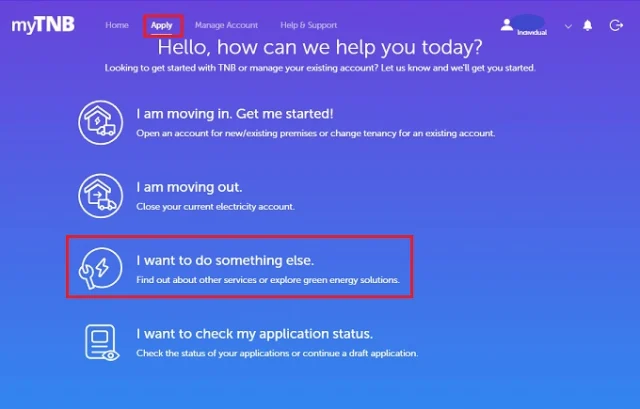
3. Select “I want to find out more about other services”.
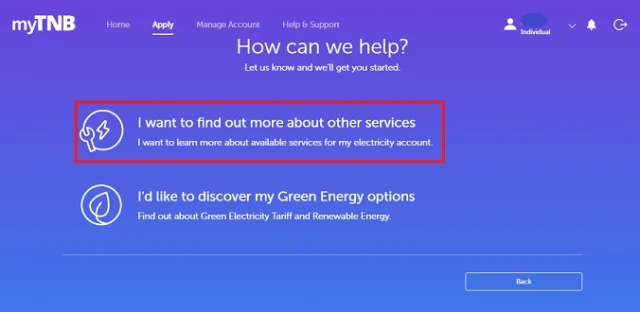
4. Check that the account number is correct, then select “Next”.
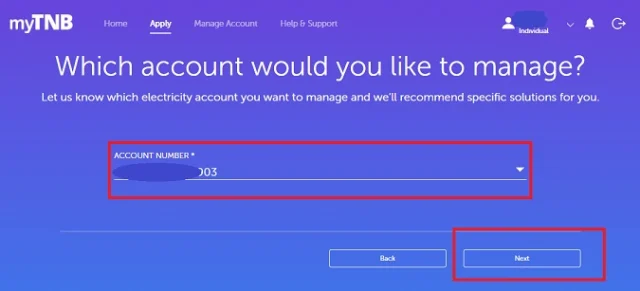
5. Select “Change my tariff”.
Follow the instructions to confirm the registered address and upload photos of both sides of the identity card (IC).
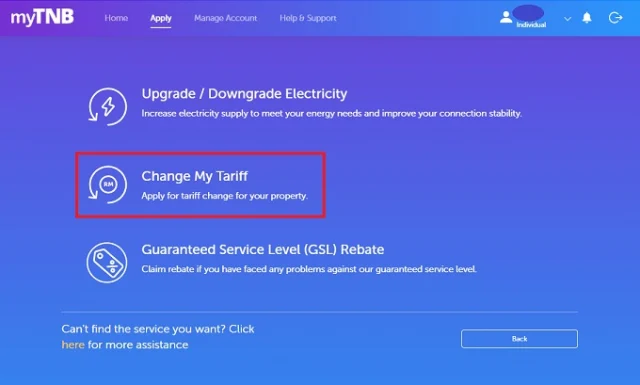
6. If eligible, the new category takes effect within 7–14 days of submission.
A processing fee of RM10 is added to the bill.
Which developments should you check?
Residents of condominiums in residential zones generally need not worry, but the original tariff is often commercial in the following cases:
• Developments mainly offering small units for singles
• Developments described as serviced apartments
• Developments above or directly connected to commercial premises
Points to note when paying
Internet and utility bills can be paid in several ways, including bank transfer, JomPAY, post offices and convenience stores.
Our advice is to avoid automatic deductions where possible.
There are three reasons:
• Billing errors are common.
• Refunds can take time.
• Cancelling automatic deductions can also take time.
These are the main concerns.
Although automatic payments are common in Japan, for these reasons it is generally safer to check and pay each monthly bill yourself in Malaysia.
If you are worried about forgetting a monthly payment, keeping extra credit in the account is another option.
For electricity payment instructions, see this guide.


